BEFORE BEING – AN EXPLORATION INTO THE THEMES OF DESTINY, HEROISM AND ORAL CULTURE BASED ON D.T NIANE’S SUNDIATA, AN EPIC OF OLD MALI
In the abstract to her seminal work, Prochaska (2009), makes an insight about destiny:
In medieval literature, the interpretation of destiny is associated with fate, wherein some force outside of the individual was so intense that the individual was powerless and bewildered in the face of a destiny that struck fear into the person, for that fateful destiny was absolute. One could not escape destiny. Something would happen. Around the corner destiny lurked, and the event actually would occur. It was that person’s destiny (Prochaska, 2009).
No matter what the circumstances, one cannot change their destiny because it is set in stone. Classical Greek and Roman mythology as a religious tradition has brought to light many of the virtues that were important to the culture of that period. The idea of predetermined fate has been brought up numerous times through extensive storytelling (for example in Gods and Heroes, Classical methodology). The well-known Greek tale of Oedipus Rex and other tales targeted toward the accomplishment of a specific destiny are written and conveyed in a variety of ways.
The Gods Are Not To Blame, an adaptation of this Greek tale with the common theme or plot of a child killing the father and marrying the mother, is found in African literature. This reveals that the idea of destiny has a worldwide aspect in addition to being known to African people. Destiny is not merely a topic for casual discussions; it involves questions of life and death, good and evil, and one has very little control over it. Even before we had a genuine relationship with the human world, our existence here on earth was predetermined and carefully arranged for each person’s uniqueness and excellence. We are warriors who must battle not only our foes but also their flaws and inner doubts. We must also be intentional about enduring the most trying times to overcome all obstacles.
Sundiata, an epic poem of the old Mali Empire, takes us on a journey of history, the legend behind it, and such rich culture that cannot only be seen but experienced throughout generations, not only in written form but through a rich tale of telling its history through griots. Destinies are not fulfilled by mere mortals but by heroes. The hero is an instrument of destiny, not only as its object but also as its subject (Kunene, 1991). Thus, heroism comes to play a pivotal role in fulfilling destinies. This hero could be an epic or tragic hero, depending on the circumstances that bind them. “Oral literature is those utterances, whether spoken, recited, or sung, whose composition and performance exhibit to an appreciable degree the artistic character of accurate observation, vivid imagination, and ingenious expression” (Okpewho, 1992). “I teach kings the history of their ancestors so that the lives of the ancients might serve them as an example, for the world is old enough, but the future springs from the past”.
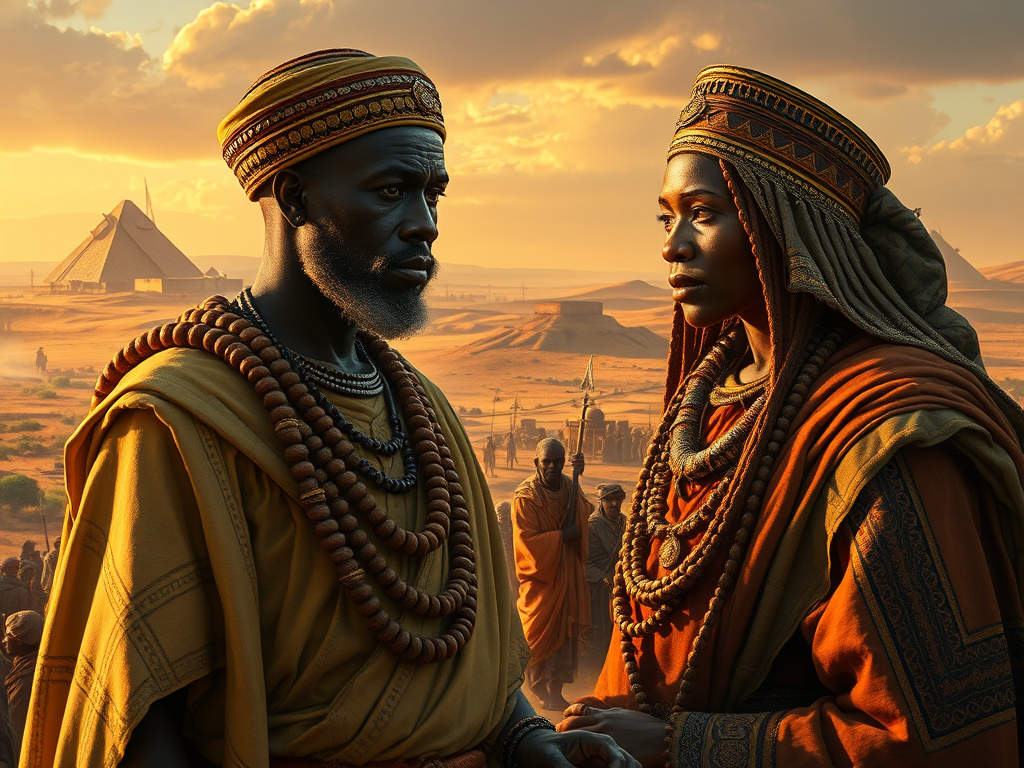
The destiny of individuals and society at large is in the hands of griots, orators of oral traditions. Their distortion, which is improbable, could cause a lot of changes. Because of this, they are not chosen or hand-picked; rather, they are born into a griot household and develop their oratory skills over time. It’s crucial to remember that destiny includes components of heroism and, most significantly, who foretells them, because false information has the potential to harm and haunt future generations. Djeli Mamoudou Kouyate, who eloquently narrates the story of Sundiata, introduces himself as the son of Bintou, a master in the art of eloquence. Sundiata, the Epic of the Old Mali Empire by Djibril Tasmir Niane, takes us on a journey to the authentic build-up of Mali and the legend behind it. The main character belonged to the Keita clan of the Malinke people from the Kingdom of Kangaba. As someone who is destined to rule Mali one day, many contradicting circumstances surround his birth, early life, and working his way to be king. However, all of these imbibed in him wisdom, courage, and hope for the future he has ahead of him. The text works well as an epic because of the divinity of the heroic character’s ability to fulfill a certain purpose. This essay intends to analyze the themes of destiny, heroism, and the essence of oral culture based on the story of Sundiata and other secondary texts within the confines of African literature through a content analysis of themes, characters and their actions, the relationship among characters, and the cultural settings of the text.
Destiny is not far-fetched when it is bound to happen; only the times and seasons may seem unending. Seers, witches, and soothsayers who can tell the future drive the action of the story, and destiny becomes one of Sundiata’s most powerful forces. No character can escape destiny, and every action has already been foretold.
A hunter as well as a seer comes from the village of Sangara to speak on the destiny of Niani while King Maghan sits with his courtier under the silk tree. “King of Mali, destiny marches with great strides. Mali is about to emerge from the night”. (pg 5) The seer speaks of the enlightenment that is bound to come to Mali and appreciates the ruling of King Maghan and his efforts to pass on the kingdom in an increased state, just as his ancestors bequeathed it to him, but whoever is to take up this mantle of restoration is not yet born. If his son, Djaran, is not his successor, then who is? Great destiny does not roll out in the safest and most comfortable spaces for the people it is tied to; it takes courage and an intrinsic determination to defy all odds. After the hunter determines the destiny of the king, two hunters come in from the village of Do in the exact manner in which the hunter had described who and what was bound to happen concerning marriage.
What is more baffling is the physical appearance of the lady who was destined to be the future wife of a great king. She was described as the ugliest that the eyes could behold with a hunched back—Sogolon Kedju, a wraith, or a manifestation of the buffalo woman. Man is seen as innately spiritual, communal, deterministic, emotive, and rational in many African communities. (Akinola, 2021).
In as much as the story is centered on the legend, Sundiata, it took the sacrifice of the kindness of the hunters from Traore to have a spiritual antidote to kill the mysterious Buffalo of Do, the sacrifice of the King to forego all the hearsay of the villagers to perform the customary rites of Sogolon as soon as possible to avoid any distractions of the birth of the heir to the throne, and Sogolon by no choice of hers had to be sacrificed to the ancestors.
“I must sacrifice you to the greatness of my house. The blood of a Konde must be split, and you are the virgin whom fate has brought under my roof”. (pg 14) So as epic writings may extensively idolize the epic character and their achievements, it takes the collective efforts of other people and their sacrifices to make that individual a hero and fulfill their destiny. This is not far-fetched from Ola Rotimi’s The Gods Are Not To Be Blamed, where in the land of Kutuje, an innocent boy who is an heir to the throne is welcomed with an undesirable fate of killing the father and marrying the mother, and the only way to escape this is his death. However, out of sheer pity, Gbonga, King Adetusa’s messenger, leaves the baby alive in the forest with a hunter and his apprentice. Eventually, this prophecy was fulfilled due to the unintentional collective efforts of people around that destined child.
The belief in evil spirits, witches, and sorcerers is a core concept in African traditional religion. Because African traditional religion is concerned with the pursuit of goodness, it is equally concerned with the prevention of evil. Africans define evil as both physical and moral. While the former is defined as any disaster that befalls an individual or community, the later is defined as any misfortune that befalls an individual or community., the latter is conceived as “any voluntary anti-social behavior or any infringement of the decrees of God, the deities, or the ancestors” (Alolo, Namawu (2007). Most often than not, the tenets of individuals in a society are dependent on their religion and culture. As African traditional believers, limitations or upliftment can befall your life because of your belief in the existence of evil spirits or sorcerers.
The circumstances surrounding Sundiata’s case are no different. At an age where it was expected of him to walk, talk, and possess the normal traits of a child, he still crawled on his four legs, sat and ate, and possessed no iota of beauty, just like his mother.
His stepmother portrayed anti-social behavior to limit or wade off the destiny of the child by constantly shaming his mother and himself and navigating her way through to enskin her son. Dagran was king when Maghan passed on.
“No matter how great the destiny promised for Mari Djata might be, the throne should not be given to someone who had no power in his legs; if the jinn loved him, let them begin by giving power to his legs’. (pg 18)
REFERENCES.
Akinola, Festus Adegboyega. “Existentialism and the African nature of man: Interrogating the concept of better human existence in Africa.” Available at SSRN 3991816 (2021).
Alolo, Namawu. “African traditional religion and concepts of development: A background paper.” RAD Working Papers Series (2007).
Etyang, Philip. “Conceptualizing Folklore and Oral Literature.”
Kunene, Daniel P. “Journey in the African epic.” Research in African Literatures 22.2 (1991): 205-223.
Law, Robin. “The’Amazons’ of Dahomey.” Paideuma (1993): 245-260.
Made, Jude Emeka. “Sacrifice in African traditional religion: differential faith issues in religions.” Journal of Religion and Human Relations 8.1 (2016): 20-35.
Mokani, Japhet. “The Role of Fate in Tragedy: A Case Study of Rotimi’s The Gods Are Not To Blame.” European Journal of Literary Studies 3.1 (2021).
Niane, Djibril Tamsir, and Ddjeli Mamoudou Kouyate. “Sundiata: An Epic of Old Mali, trans.” GD Pickett. Edinburgh Gate, Harlow: Longman Group Ltd (1965).
Okpewho, Isidore. African oral literature: Backgrounds, character, and continuity. Vol. 710. Indiana University Press, 1992.
Tymieniecka, A. T., and Bernadette Prochaska. “Destiny in the Literature of Walker Percy, Leo Tolstoy and Eudora Welty.” Existence, Historical Fabulation, Destiny (2009): 283-292.

Leave a comment